Case study · Paid client work
Agency Command Center: Meta Ads + GoHighLevel
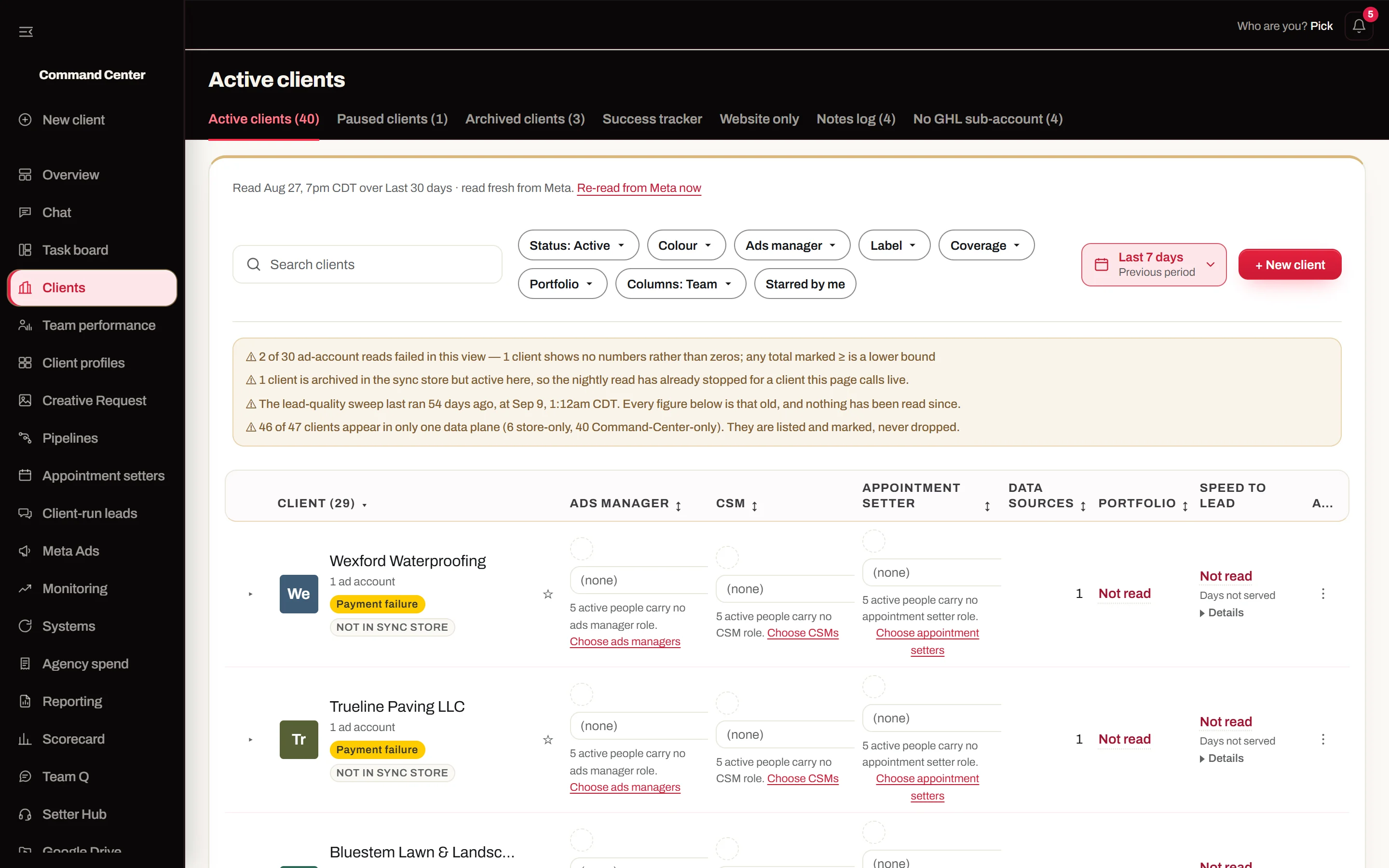
A Meta ads agency runs about 50 home-service contractors. Every morning the system reads each client's ad spend, billing status, leads and speed to lead from Meta and GoHighLevel, and the app puts the whole book on one screen. When a number can't be read, it says so instead of showing a zero.
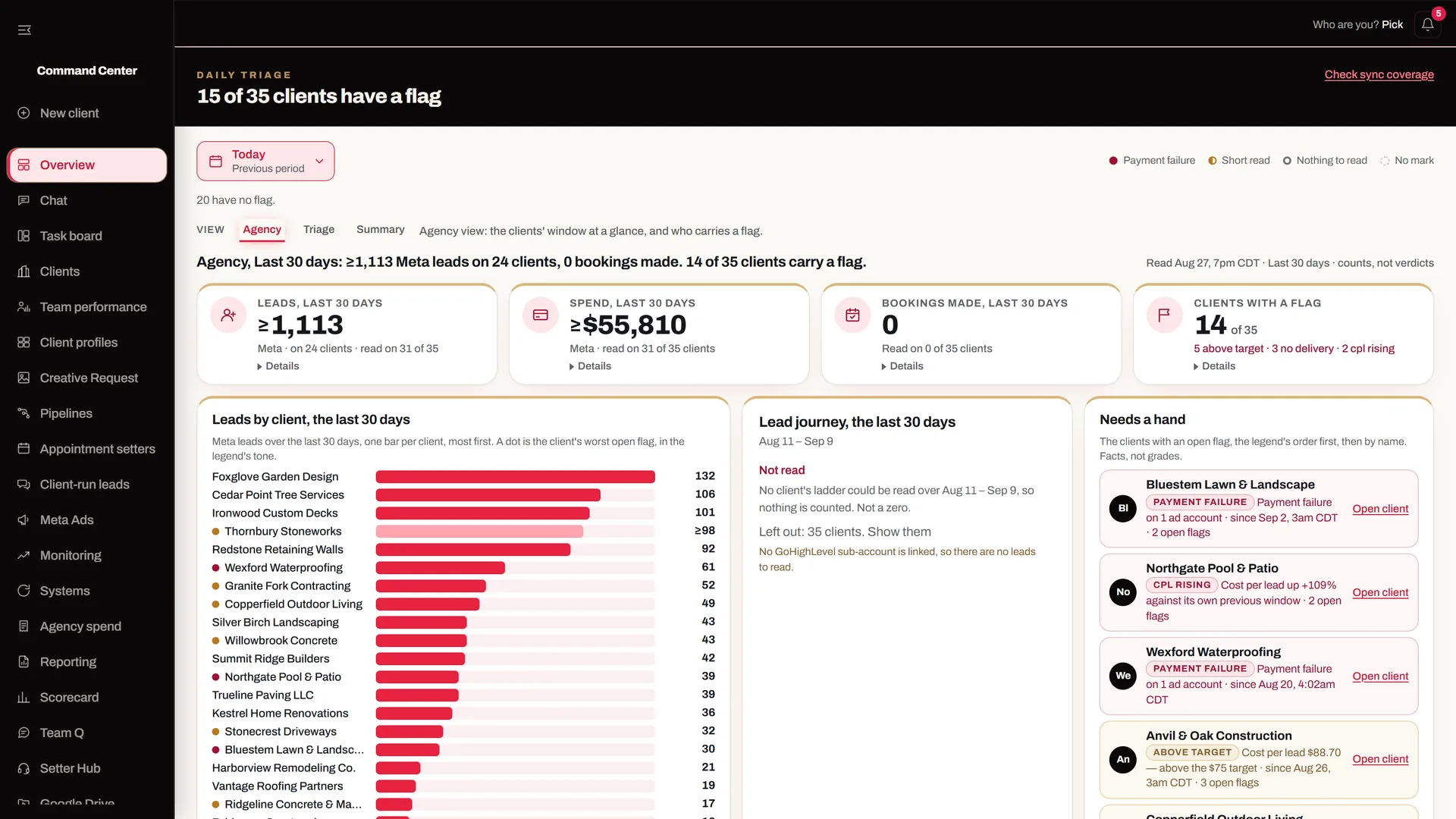 Sample data
Reports that kept running after the data stopped
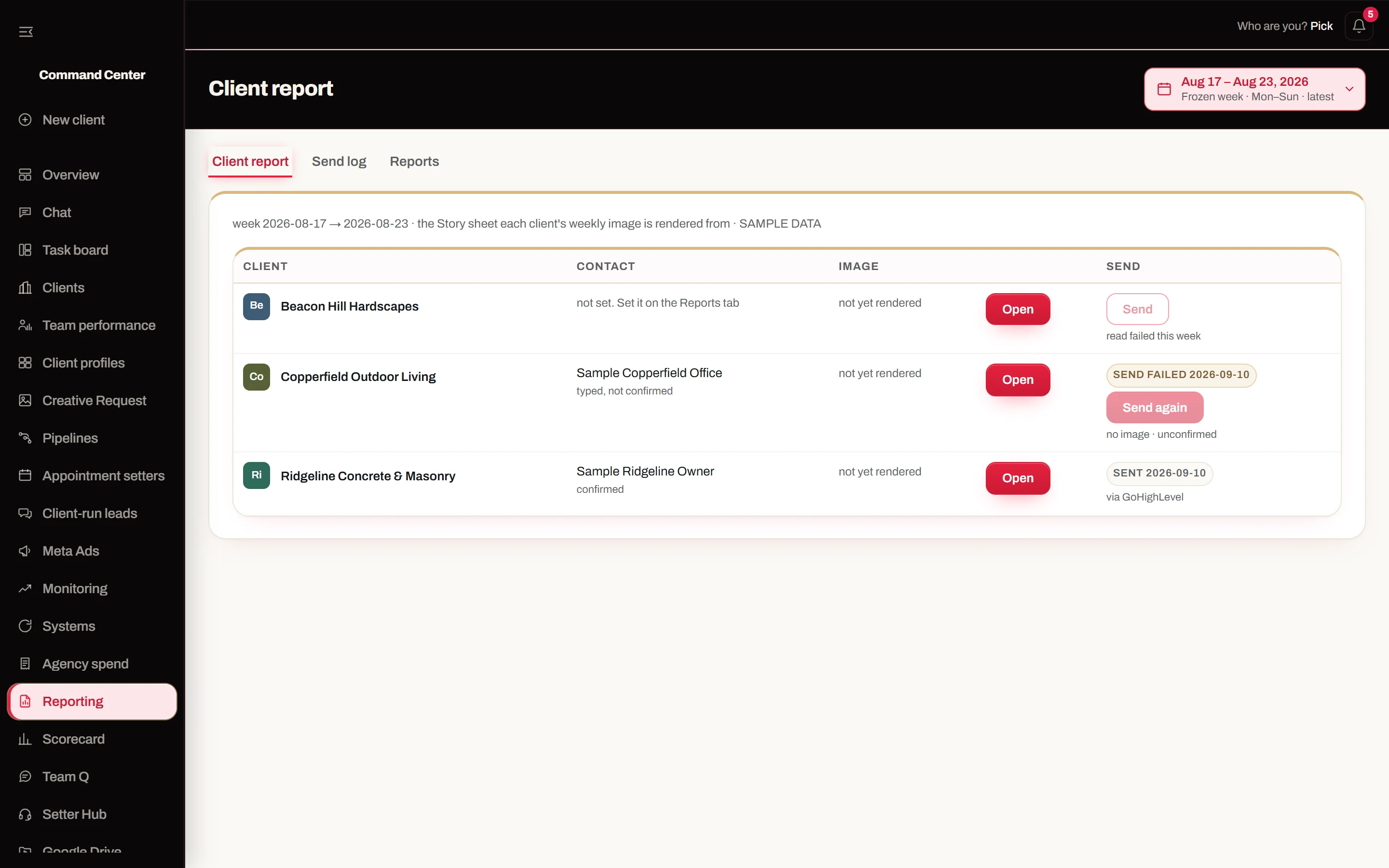
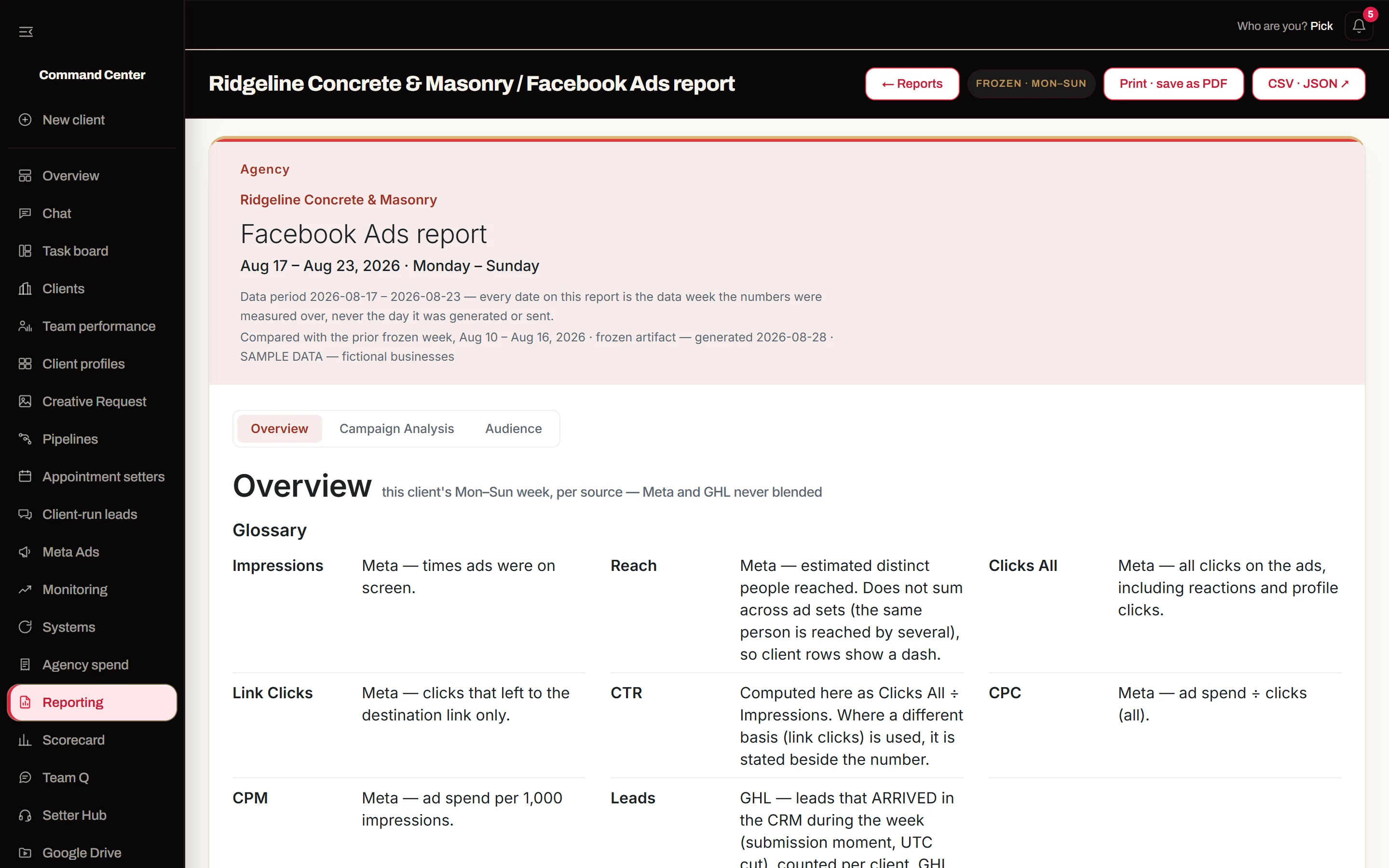
The agency's owner asked for a genuinely good dashboard, not a repair job. The team checks client health between calls, and every client gets a performance report each Friday.
The audit found the numbers underneath had stopped. The reporting pipeline's stats feed had been dead for about six and a half months while every run still reported success, because each step swallowed its own errors. It covered roughly 36 of the agency's 108 ad accounts, and the dashboard the team already had was failing most of its CRM reads.
Measured in the audit
About six and a half months, and every scheduled run in that window still reported success.
On the dashboard the team was already using.
Leads live in GoHighLevel, and the old pipeline never read it.
Failures louder than numbers
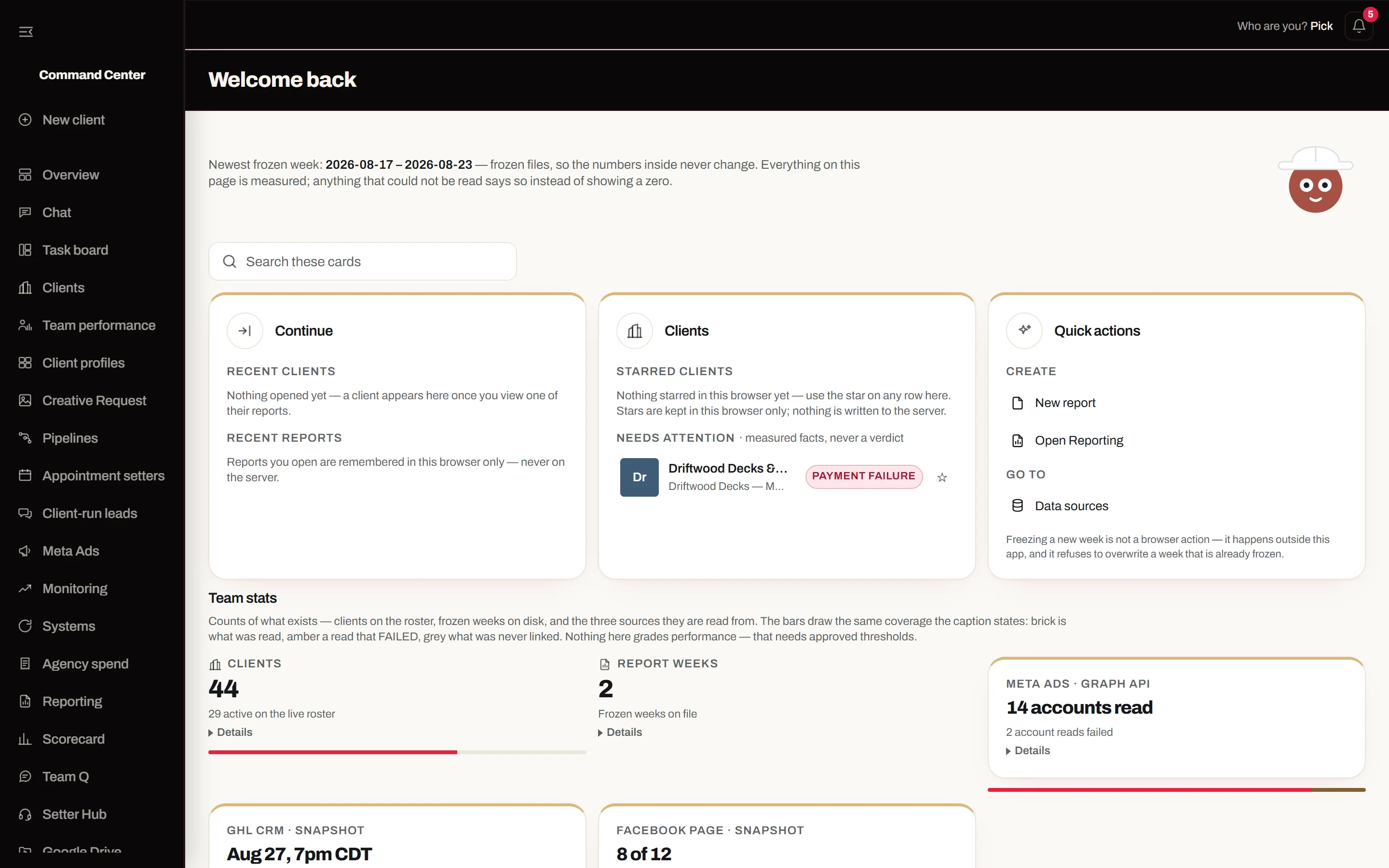
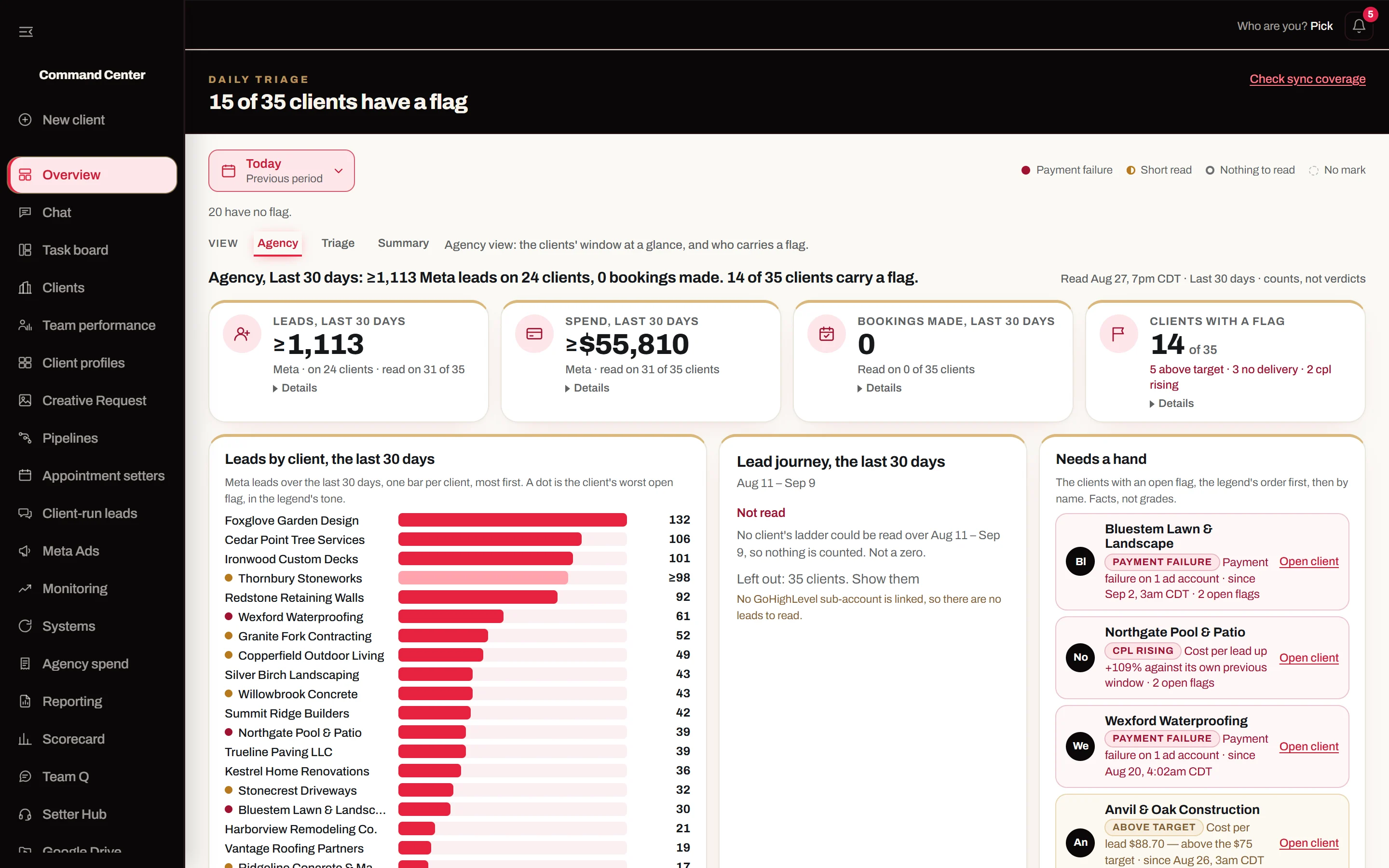
The owner wanted nothing that looked like a generic SaaS template. I added one rule of my own: the app states facts and never grades a client by itself. Colour marks facts such as billing trouble, zero delivery, a failed read or a stale sync. A judgement like a cost per lead above target appears only when the owner's written rulebook sets that target. The owner's sign-off is recorded next to the rulebook; it never holds an alert back.
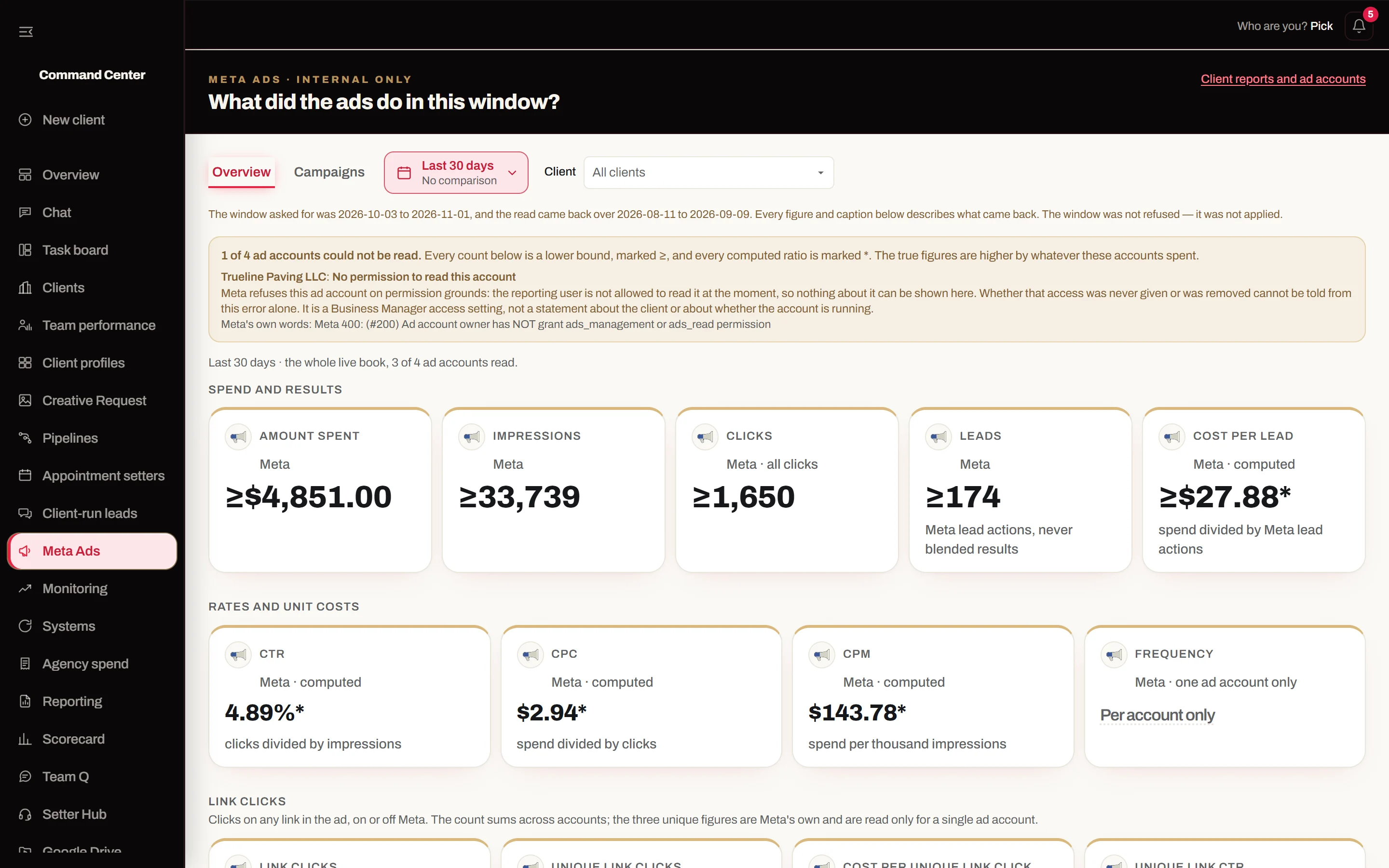
Figures are labelled with their source and whether they were measured or blended. A failed read shows as READ FAILED, never as a zero, and a partial read turns totals into lower bounds. Nothing writes to Meta or GoHighLevel. The system was built in blocks the owner approved one at a time, running alongside the agency's existing automations instead of replacing them.
From Meta and GoHighLevel to one screen, every morning
- SourcesMeta Ads + GoHighLevelRead-only access
- Schedulen8n syncsScheduled every morning
- GateSigned ingestChecks the signature before writing
- StorePostgresDaily rows plus a run log
- SurfacesCommand center + ClickUpOne screen, alerts in ClickUp and the app’s chat
- 01
Audit before building
I inventoried all 108 ad accounts and 73 GoHighLevel sub-accounts first. The audit flagged 12 ad accounts with billing problems, 7 whose timezone put their daily numbers out of step with the rest, and about 15 clients that seemed to have a second ad account splitting their history. It also showed ad-level attribution was possible: 82% of Meta leads in GoHighLevel already carried the ID of the ad behind them.
Meta Marketing API · GoHighLevel API · read-only - 02
Sync every morning
Scheduled n8n workflows on the agency's own instance read spend, leads, billing status, pipeline stages and speed to lead each morning. Two of the heaviest GoHighLevel reads first hit n8n Cloud's 60-second limit on code steps, so each now runs in a child workflow, one sub-account at a time.
n8n · daily, 6 to 8 am Central - 03
Signed writes, logged runs
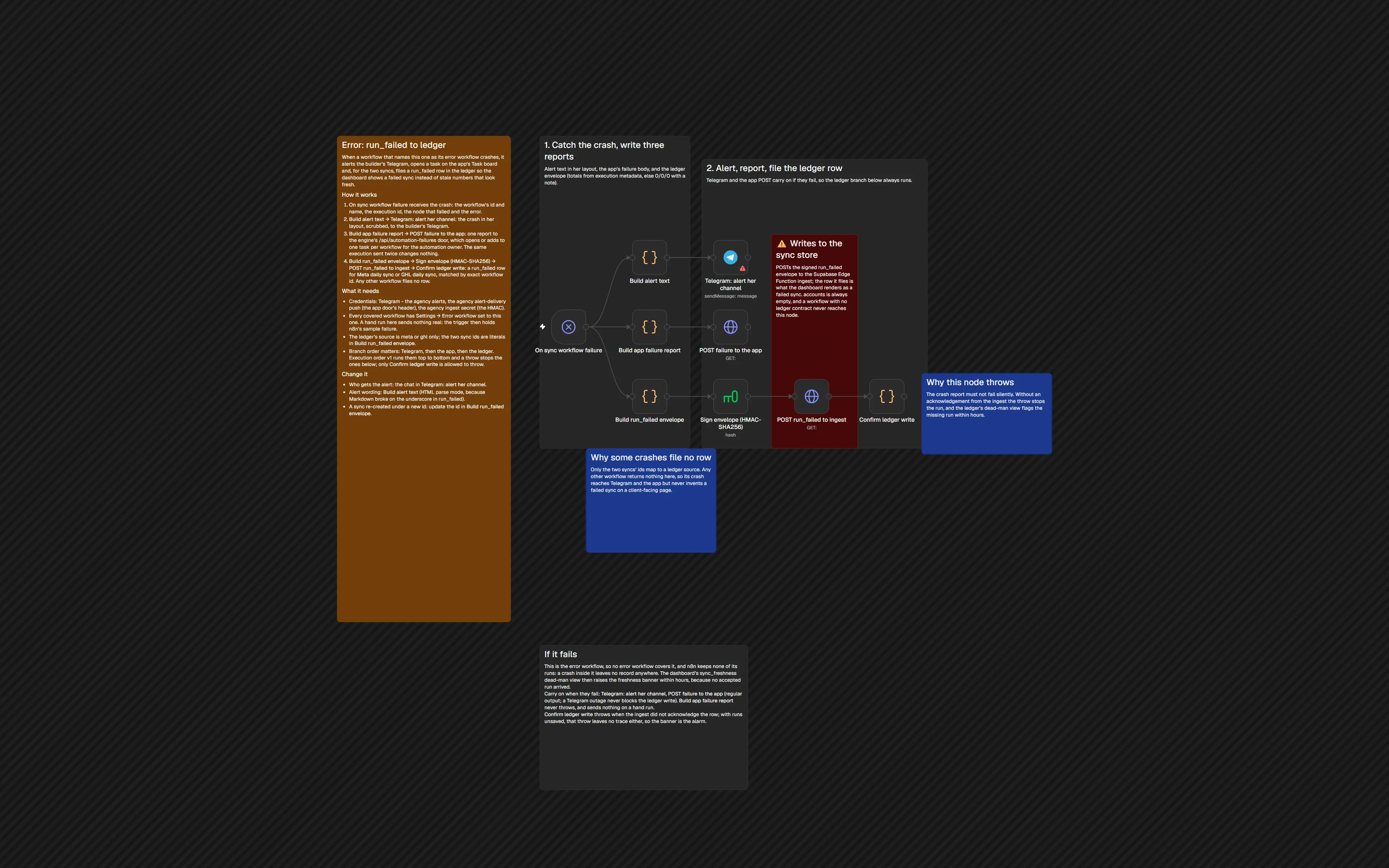
Each sync sends its rows as one signed envelope to an edge function. The function checks the signature, the timestamp and the schema version before any metric row is written. A Meta or GoHighLevel sync that crashes still files a failure row, so a missing day shows up instead of passing silently.
Supabase Edge Functions · HMAC · Postgres - 04
Screens built around the daily check
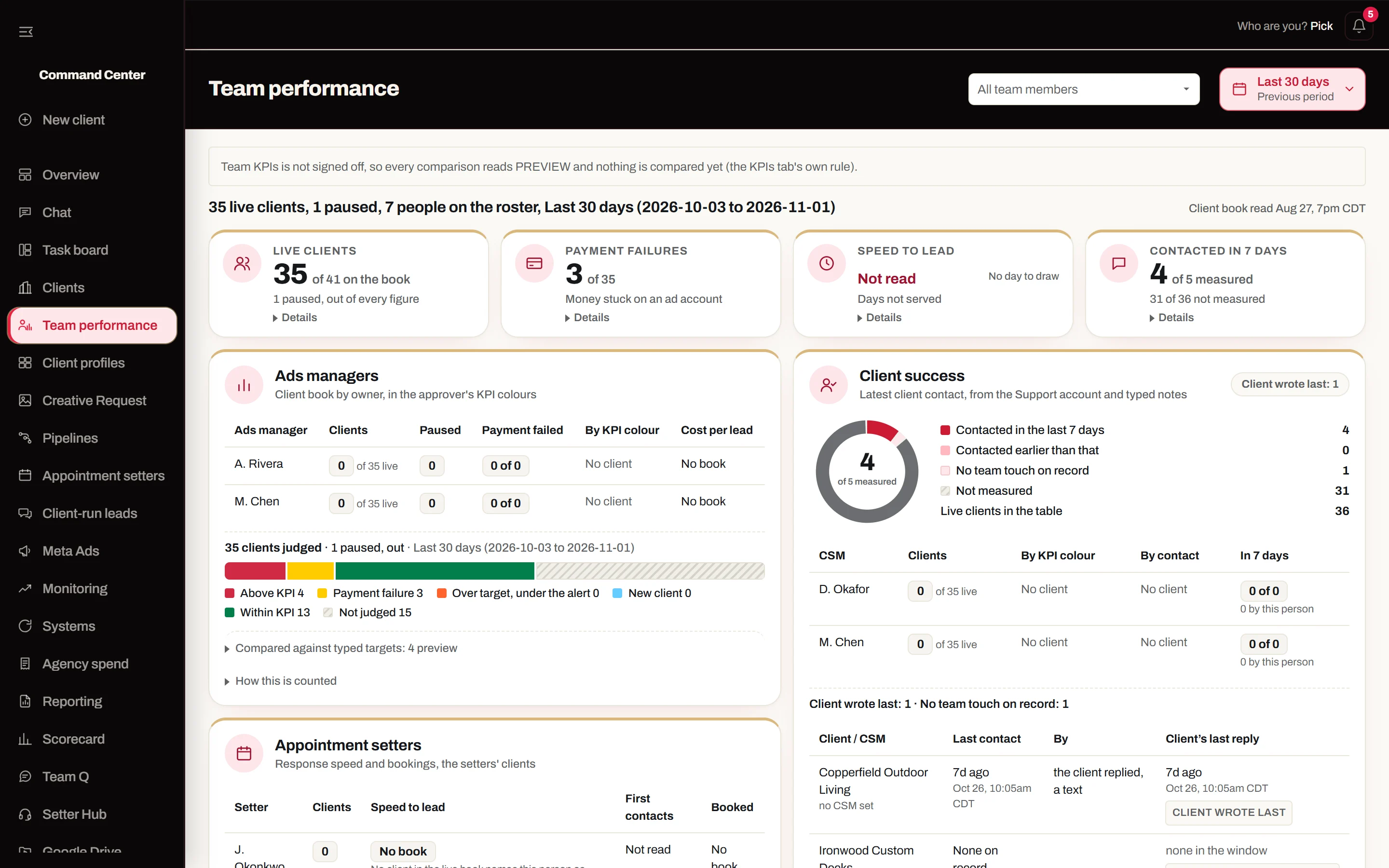
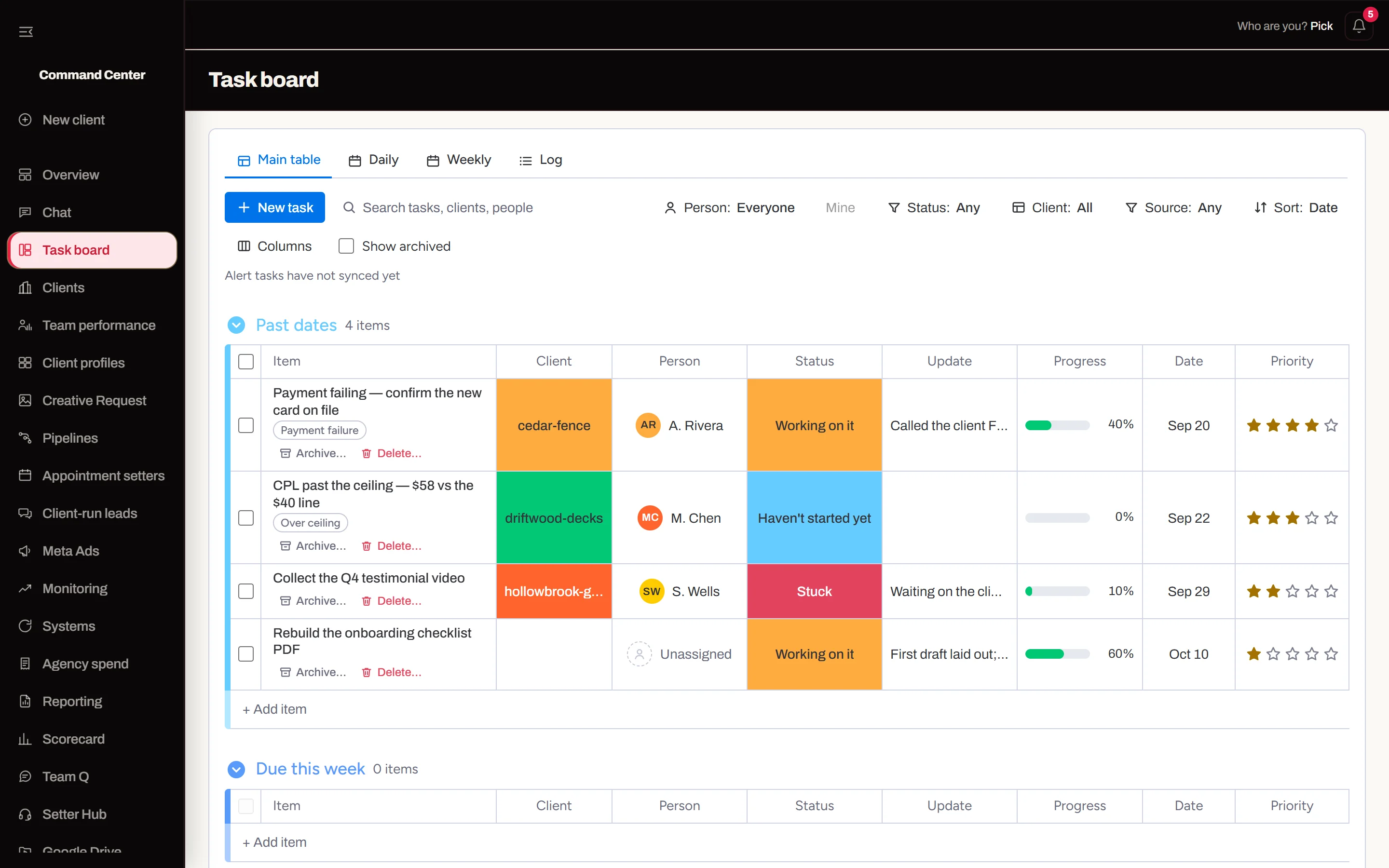
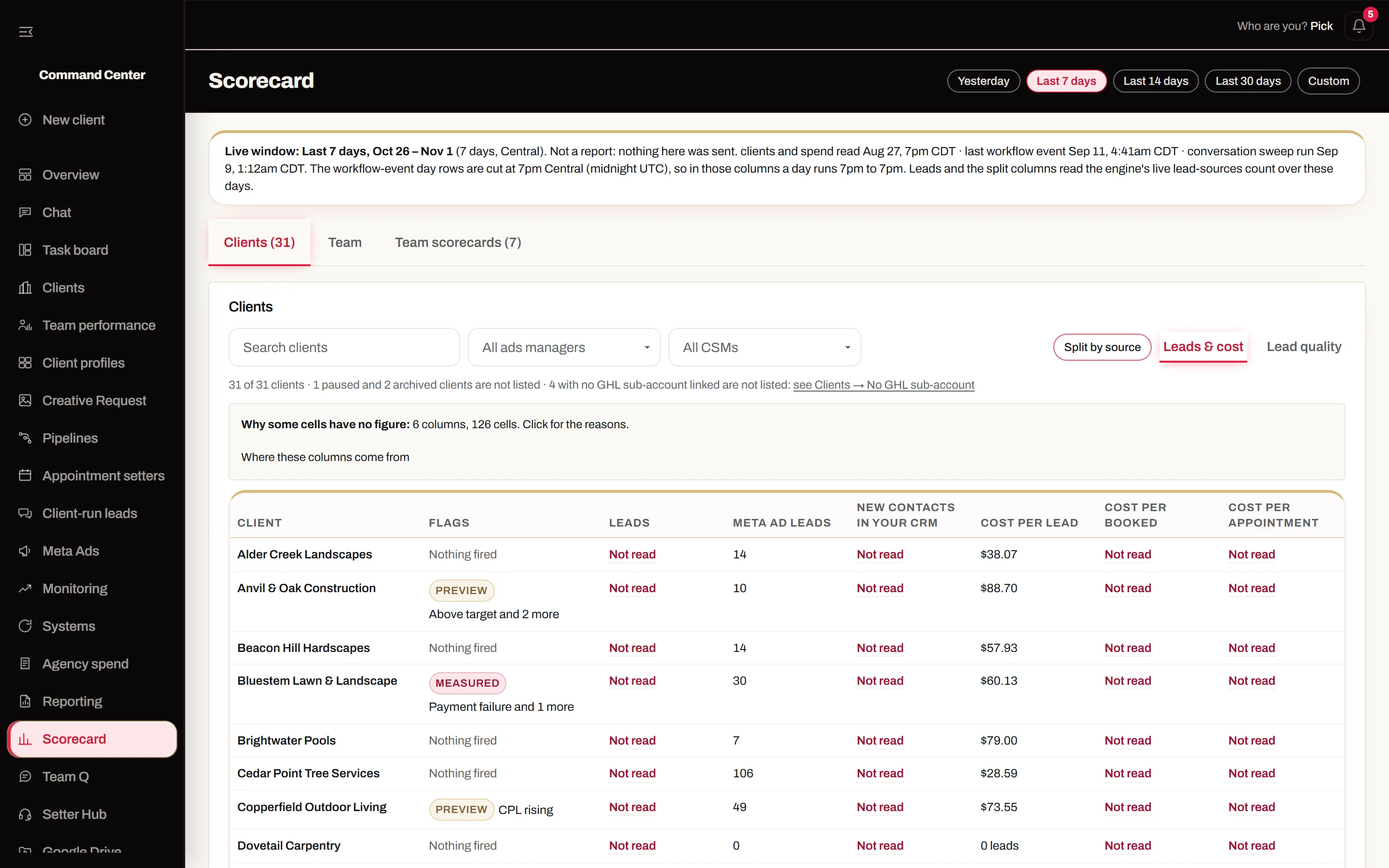
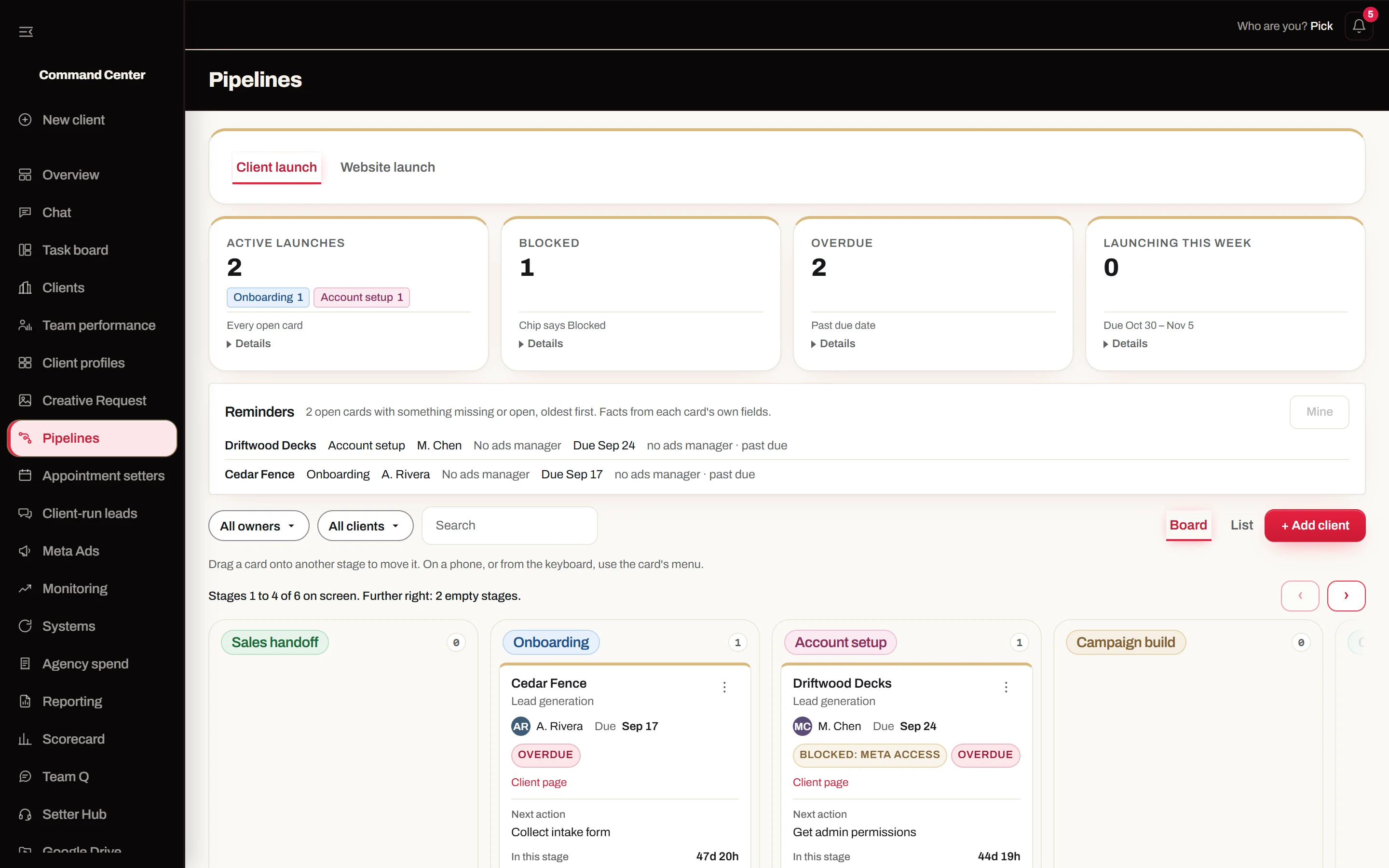
Overview triage, Clients, Meta Ads, Monitoring with incidents, rule previews and data freshness, weekly reporting with per-client scorecards, plus Team and Data. It works on a phone too, because the team checks between calls.
Next.js · TypeScript · Tailwind · Netlify - 05
Alerts in each client's channel
The alert rail posts each alert in the client's own ClickUp channel and the app's team chat, tags the client's CSM, follows up after 48 hours and posts a cleared note once the problem is gone. Before go-live, a test run posted 6 alerts into one channel without tagging anyone, and a rerun added no duplicates.
ClickUp + app chat · live
The automations behind the screens
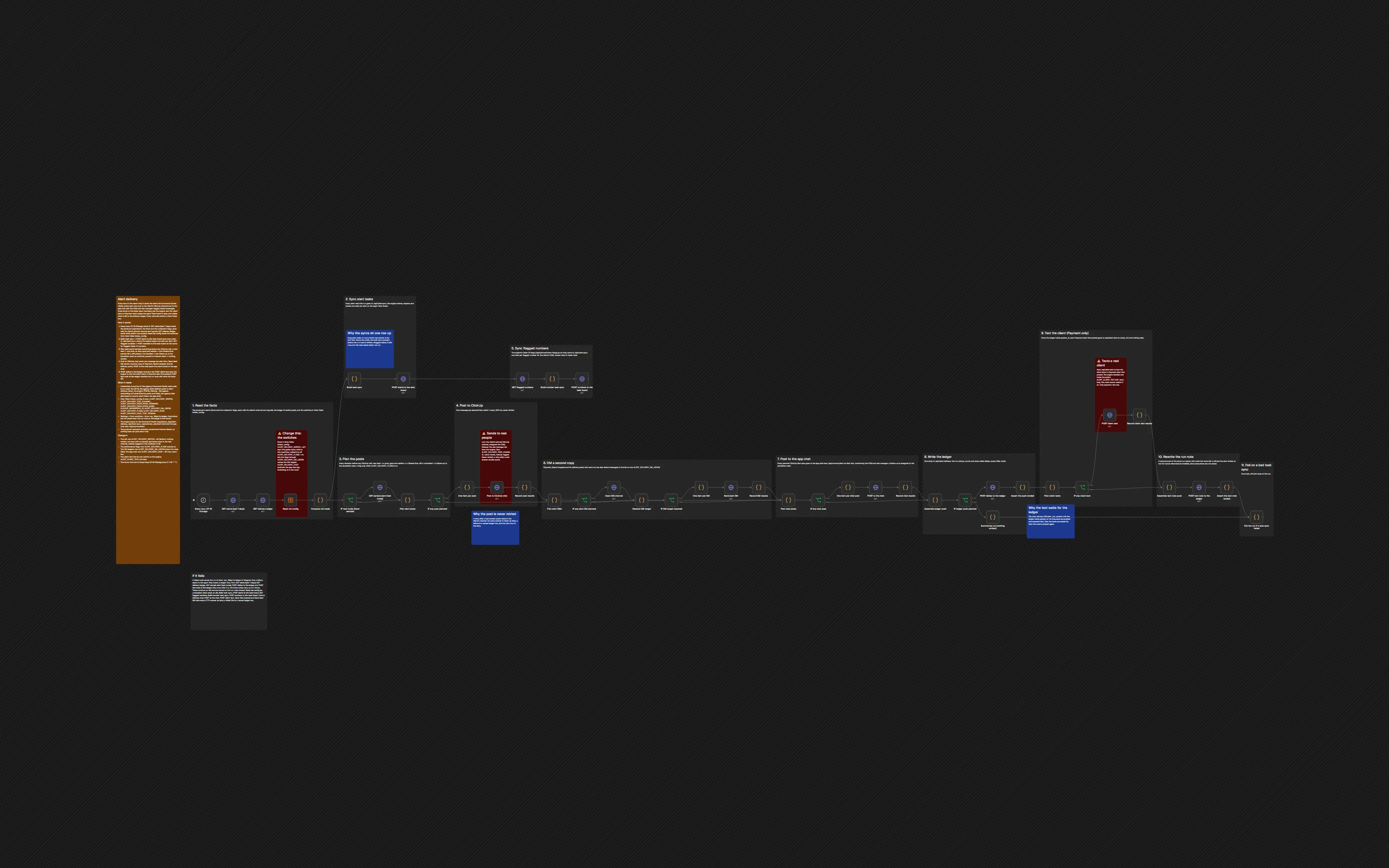
Twenty-four n8n workflows run on the agency's own n8n Cloud, plus the GoHighLevel workflows around them. The map shows every one of them, moving: what starts it, what it reads, where it writes. Names in the notes are anonymized.
24 workflows on one map. Five lanes plus the error rail. Bold workflows are the ten featured; open any of them to see what starts it, what it reads and where it writes. +N more opens the rest. Static version, full size →
Below, five of the canvases as they run today. Use the arrows or swipe, and tap or click any canvas to see it full screen.
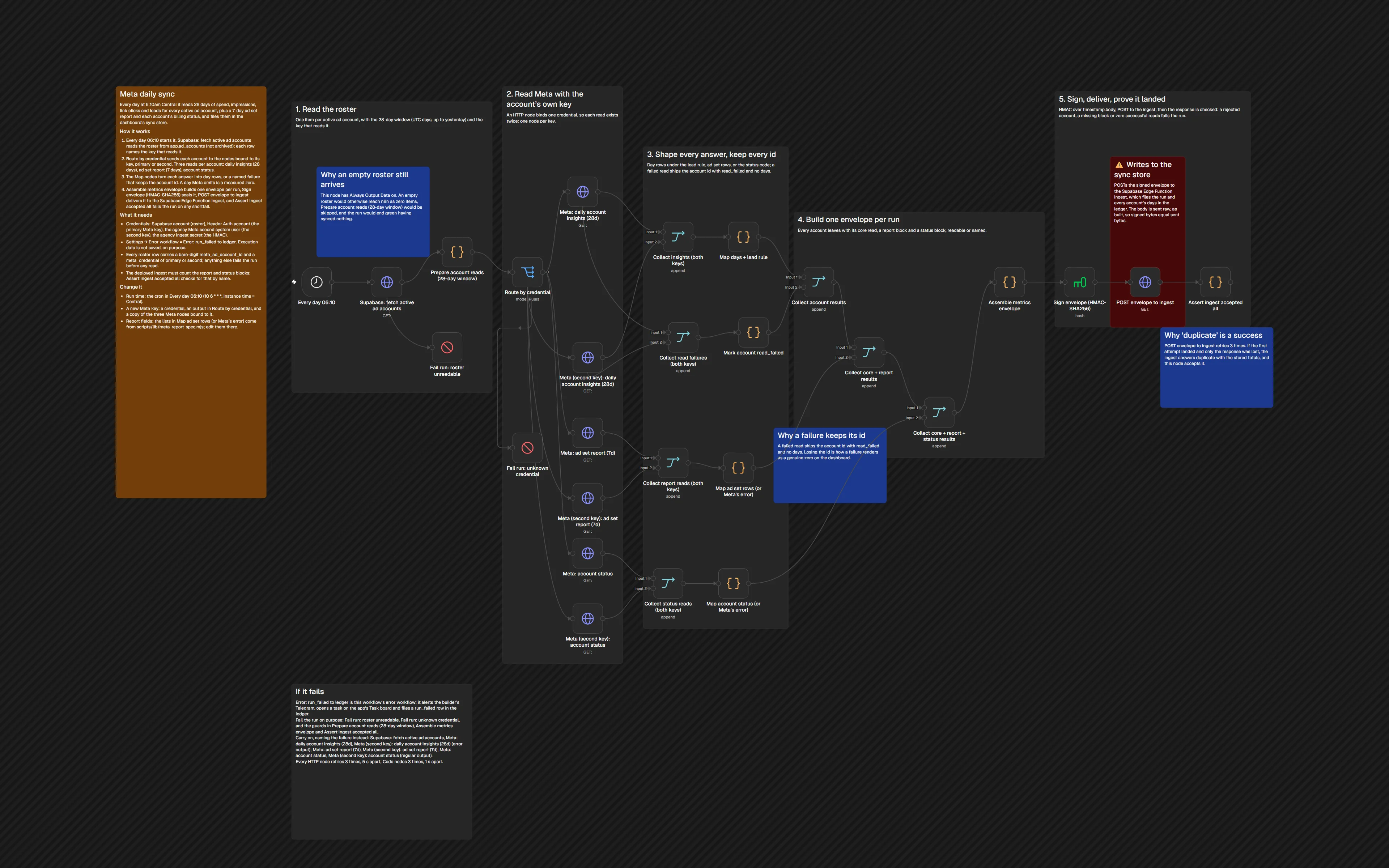
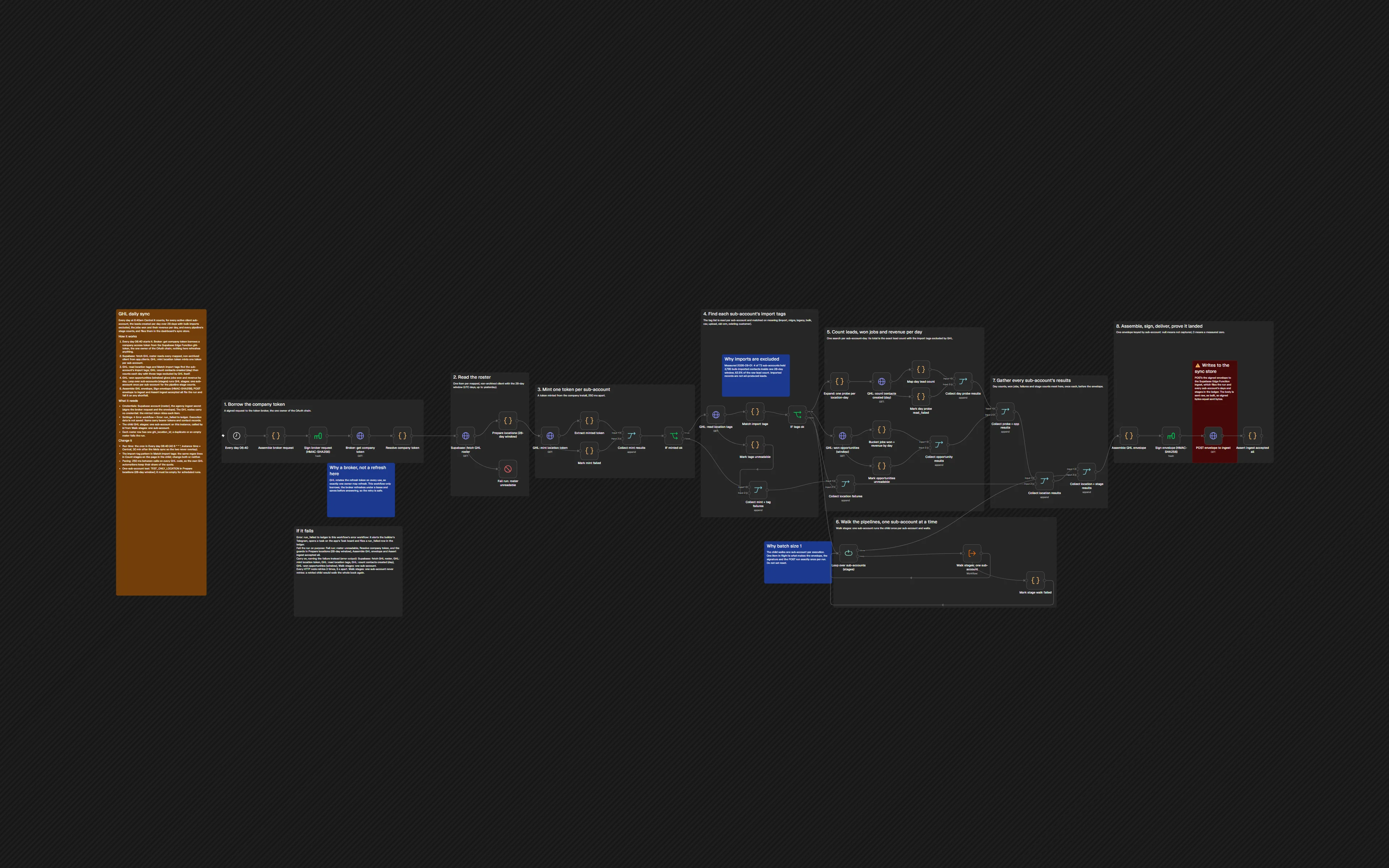
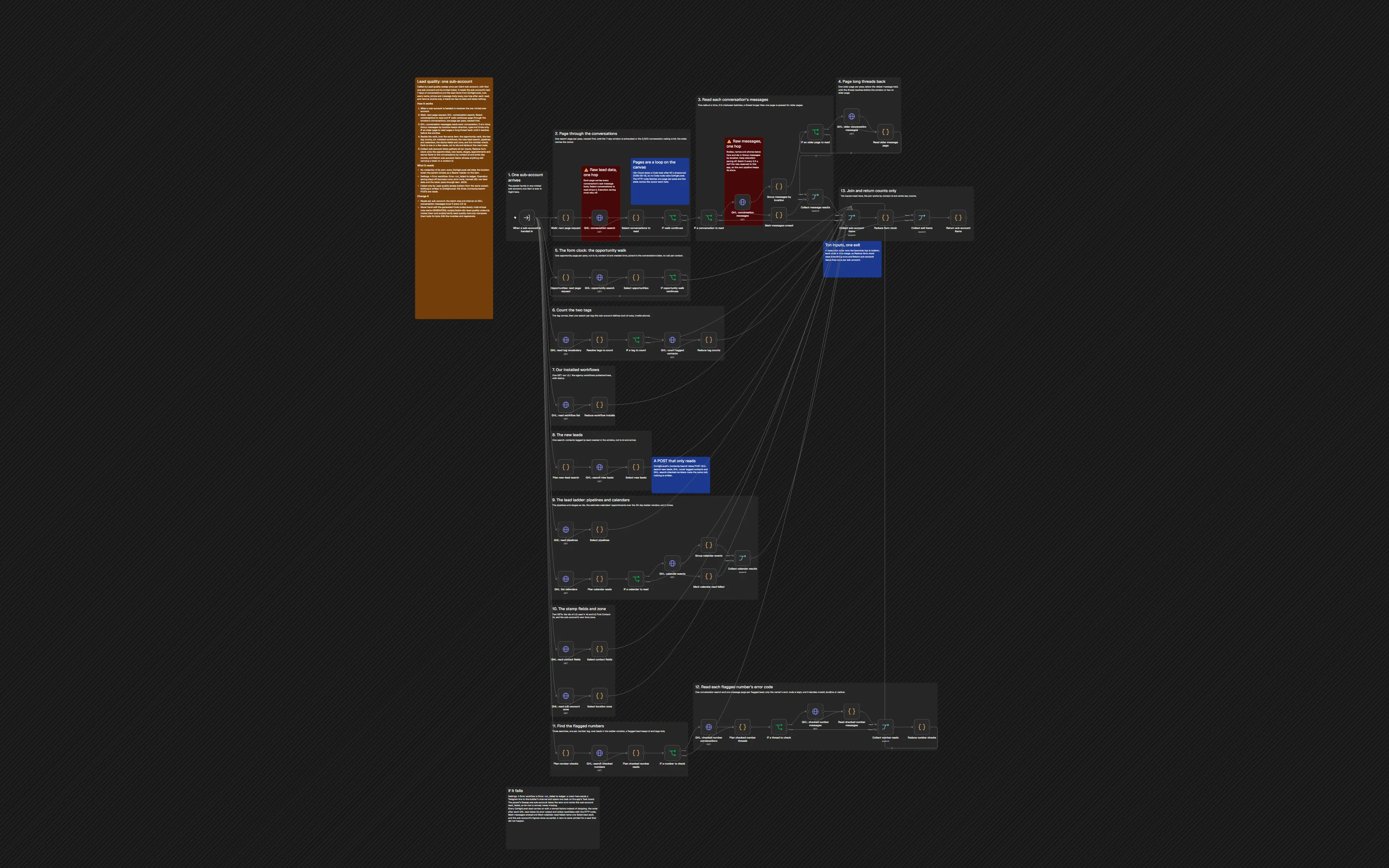
Built for the daily check
The app as it runs today, on its built-in sample data: invented contractors and numbers, the agency's branding removed. Swipe or use the arrows; tap or click any screen for full size.
Numbers the owner can trust at a glance
On the first live read, with zero failures.
On the first full sweep. The same day, the old dashboard was failing 31 of its 38 CRM reads.
Meta and GoHighLevel sync each morning on the agency's own n8n, and every scheduled run is logged, failures included.
Three weeks in, the app, the syncs and the database all run on accounts the agency owns, and the work continues as the owner reviews each release. Since 2026-11-12, twelve GoHighLevel Conversation AI assistants answer the leads nobody answered and hand each one to its contractor with a summary.
Available for remote work
Running Meta ads for home-service clients?
If your team checks client health by opening Ads Manager and GoHighLevel one account at a time, I can build the screen that does it every morning, on accounts you own.